
You’ve probably run a social media SWOT analysis before, even if you didn’t call it that.
Every time you’ve looked at what’s working, what’s flopping, and where to grow, you’ve already done the exercise.
That’s the foundation of a social media SWOT analysis. Keep reading to learn how to do it step by step.
Key takeaways
- A social media SWOT analysis looks at where you’re excelling (strengths), where you’re not (weaknesses), what you could tap into (opportunities), and what could derail you (threats).
- A SWOT analysis helps social marketers set ambitious yet realistic goals, spot risks early, keep up with trends, and stay competitive.
- Run one when you’re planning budgets, launching campaigns, or doing your annual social media audit. Basically, anytime you’re making a big call.
A social media SWOT analysis is a framework marketers use to evaluate their social media performance by looking at four areas: strengths, weaknesses, opportunities, and threats.
Here are a few scenarios where a social media SWOT analysis could come in handy:
- Deciding whether to join a new social media platform
- Rebranding or repositioning
- Making budget decisions
- Planning campaigns
- Identifying emerging trends
In short, a social media SWOT analysis helps you make smarter decision-making about where and how to invest on social. It also keeps your strategy grounded in real data, not guesswork.
What are the components of a social media SWOT analysis?
There are four components:
- Strengths: What your brand is doing well on social media, like strong engagement, high follower count, or consistent branding
- Weaknesses: Areas where your brand could improve, from inconsistent posting to off-target messaging
- Opportunities: External factors that give your brand a chance to grow, like emerging trends or new platform features
- Threats: External risks that could hurt your performance, like algorithm changes or increased competition
Strengths and weaknesses look at internal factors you can control, while opportunities and threats focus on external factors. These things happen outside of your control (but you still need to monitor and respond to them).

A social media SWOT analysis helps you see the bigger picture, so you can see what’s working, what’s not, and decide what to do next.
Here’s why you should conduct a social media SWOT analysis:
Set impactful (but realistic) goals
For goals to be effective, they need to be ambitious but achievable. A social media SWOT analysis helps you understand what’s actually possible by combining your past performance with industry benchmarks.
In other words, a SWOT analysis grounds your goal-setting in both internal data and external reality. That’s how you set business goals that actually hold up.
We’ve got separate blog posts to help you with the details of setting SMART goals and social media KPIs.
Identify and mitigate risks
Weaknesses and threats might sound scary. But taking a good, hard look at these areas will help you prepare for potential curveballs.
Weaknesses reveal internal risks related to process, tools, and teams. Threats point to external challenges like algorithm shifts, compliance issues, or economic changes.
For example, a recent study found that about 80% of people expect companies to be transparent about their use of AI, and 53% have privacy concerns.

Source: Forbes
How does that impact a social media SWOT analysis? It highlights the need for transparency, and gives you a chance to put guardrails in place, like labeling AI-generated content or setting clear standards for how AI gets used.
Risk management is an important part of your social media strategy. A SWOT analysis makes sure you’re focusing on the right risks at the right time.
Stay competitive
A social media SWOT analysis forces you to think beyond your own brand bubble. It considers the broader landscape and upcoming changes, so you’re always a step ahead.
For example, over half (51%) of adults start holiday shopping in October or earlier. This presents a clear opportunity to target these early shoppers, but only if you also get things moving earlier in the year.
Another report found that Buy Now, Pay Later (BNPL) transactions hit a new high in 2025, driving over $1.03 billion in online sales on Cyber Monday alone. If your competitors offer flexible payment options, it’s worth testing in your own strategy.

Source: Adobe Analytics
Allocate resources effectively
An internal social media analysis only considers the strategies you already use. That’s a good starting point for figuring out how to allocate your social media resources. But it misses all the strategies you haven’t tried.
A SWOT for social media takes things further by incorporating data from beyond your organization.
For example, recent data from HubSpot shows that short-form video has the highest ROI of any content type.

Source: HubSpot’s 2026 State of Marketing Report
That doesn’t mean short-form social videos will provide the best ROI for you specifically, but it’s an indication that you should make room in your content strategy to test it out.
#1 Analytics Tool for Growth
Beautiful reports. Clear data. Actionable insights to help you grow faster.
Get a better picture of your performance
You already use social analytics to understand your performance and report to stakeholders. But reporting in a bubble can give you a false sense of the possibilities.
Conducting a SWOT analysis includes external data like industry benchmarking and competitor research. This reveals the true level of your success compared to your peers.
Look beyond social media
The insights from a social media SWOT analysis don’t just apply to marketing. They’re often just as valuable for product and customer support teams.
Pay close attention to weaknesses and threats, then build partnerships across departments to course-correct.
Social media is often where customer issues show up first. That’s actually a good thing. Spotting patterns in complaints or negative feedback helps you fix problems much faster than you ever could without social media analysis in place.
To conduct a social media SWOT analysis, follow these steps:
- Audit your social media performance
- Identify strengths
- Discover areas for improvement
- Look for opportunities
- Evaluate potential threats
- Turn insights into action
1. Audit your social media performance
Start by gathering data on your social media performance. This includes metrics like engagement, follower growth, reach, and conversions.
Use your social media analytics tools to understand how your content is performing across platforms. Then, look at the competition to see where you stand.
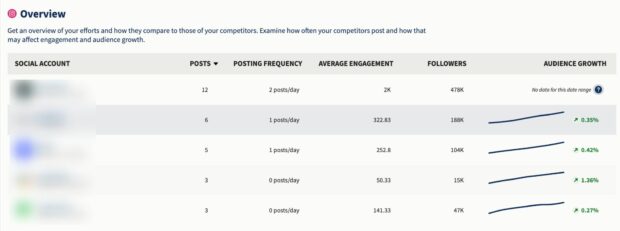
Hootsuite’s industry benchmarking and competitive analysis features are really useful for getting an inside look at your competitors’ performance and how you stack up.

You can see how you compare against your industry based on profile impressions, audience growth rate, and post engagement rate. You can also see how you compare against specific competitors.
Looking at social share of voice and social sentiment is key to understanding how your brand is performing. Hootsuite Listening surfaces these metrics, giving you a clearer picture of where you stand and how people feel about your brand.

2. Identify strengths
Your strengths are where your social media performance stands out, especially compared to your past results.
Start by reviewing your analytics to see what’s consistently working well. Are certain content types driving high engagement? Are specific platforms growing faster than others?
Don’t forget to compare these metrics against competitors. This gives you enough context to see where you have a true competitive advantage.
Pro tip 💡: Not sure what a good engagement rate looks like for your industry? Check out this guide for the latest benchmarks across 10+ industries, plus a free engagement rate calculator.
3. Discover areas for improvement
Spotting your weaknesses follows a similar process, but with a focus on where performance is falling short.
As always, start with your own metrics. Compare your most recent results with results from previous social campaigns or time periods.
Be specific here. For instance, it’s not enough to say you’re falling behind the competition on TikTok. Dig into which content types, formats, or campaigns aren’t delivering.
It’s also important to look at internal factors like budget cuts, team changes, or past social media crises. All of these can impact performance.
A dedicated social analytics tool like Hootsuite provides a full picture of your cross-platform performance. You can see how engagement and conversions fluctuate across your accounts over time.
4. Look for opportunities
To look for new opportunities, you need to keep a pulse on what’s happening outside your brand. That means looking beyond your own data to spot trends in your industry, across social platforms, and in the broader economic/business climate.
Social listening can do a lot of heavy lifting here. It helps to surface trending topics, keywords, and conversations you can tap into. For example, if conversation volume jumps for a specific keyword, that’s an opportunity to create content that’s in demand.
Hootsuite Listening can help you spot trending keywords and broader themes in your niche, both of which can inspire new content ideas.

Monitoring social sentiment is also crucial. For example, going viral on a particular post might look like a strength. But if your social sentiment is overwhelmingly negative, you may have uncovered a weakness in disguise.
Pro tip 💡: Bookmark our 2026 Social Media Marketing Trends Report to know what to expect from social this year.

#1 Easy Social Listening
Brand mentions, trending topics, and sentiment at your fingertips. Enhance your social strategy with the insights that matter.
5. Evaluate potential threats
Just like opportunities, threats are external factors. So, it’s important to evaluate possible changes that threaten your status quo.
For example, most marketing teams know the pain of algorithm changes. Therefore , algorithm updates need to be on your radar so you can plan to pivot, like by focusing on social SEO.
Social listening can also help you spot emerging risks early — whether it’s a spike in negative sentiment, a competitor entering a new market, or changes in how your audience engages with your content.
Spotting these risks early gives you a chance to respond, like testing new formats, diversifying your content mix, or adjusting your posting frequency.
6. Turn insights into action
Once you’ve filled in your SWOT analysis, the final step is turning those insights into action.
Use your strengths to capitalize on opportunities, and create a plan to address weaknesses and mitigate threats. This might include shifting budget, trying new social platforms, launching new initiatives, or updating internal processes.
Remember: a SWOT analysis is only valuable if it leads to action. Make sure you use these insights to actually optimize your marketing strategy.
When should you run a SWOT analysis?
You should run a social media SWOT analysis when it’s time to make strategic decisions, such as planning budgets, launching campaigns, or conducting performance audits.
Here are the most common times to run a SWOT analysis:
Making budget decisions
A detailed SWOT analysis can help you anticipate new strategies or features as you plan your annual budget. It can also help identify opportunities to reallocate resources more effectively. All of this works to maximize ROI.
Launching a new campaign
Before you launch a new campaign, it’s important to look back at what has worked well — and not so well — in the past. This applies to both your own campaigns and those of your competitors.
You don’t want to copy your competitors’ ideas. But you can certainly learn from their biggest wins and losses.
Your SWOT for social media also makes sure you’re on top of the latest shifts in social culture. This is important for spotting opportunities for new campaign ideas and directions. Be sure to test any new strategies with a small budget instead of making wild swings.
Performing an annual social audit
An annual social media audit is an important strategic check-in. You look at your social accounts, check for necessary changes, review performance, and plan your strategy for the year ahead.
A social media SWOT analysis provides context for your social audit. It helps you evaluate results more accurately and highlight new ways to pivot your social media efforts.
And it goes both ways: your social audit provides detailed information for the internal portions of your SWOT analysis. Social media strategic planning benefits from doing both activities at the same time.
Cross-pollinating the data makes both your SWOT and your audit more effective.
1. Hootsuite

Hootsuite is a useful tool for running a social media SWOT analysis, since it brings together performance data, industry benchmarks, and competitive insights in one place.
You can see how your results stack up across platforms at a glance. Side-by-side comparisons highlight your strongest channels and content, so you can quickly spot your strengths and weaknesses.
The industry benchmarking tool shows how your results compare to industry averages, while the competitive analysis feature measures your results against up to 20 competitors of your choice.
Plus, Hootsuite Listening helps you track social sentiment, monitor conversations, and keep an eye on competitor activity. This makes it easier to spot emerging opportunities and potential threats in real time.
2. Meta Business Suite

Source: Meta Business Suite
Meta Business Suite gives you a quick snapshot of your social media performance on Facebook and Instagram with built-in analytics.
It helps you see which platforms and content are driving results, so you can start identifying strengths and weaknesses for your SWOT analysis.
The tool also offers basic benchmarking features, which gives you a bit of external context. Keep in mind that it only covers Meta platforms, so you’ll need more tools to analyze other channels.
3. Sprinklr

Source: Sprinklr
Sprinklr offers solid social media analytics and customer insights, which can help you evaluate your strengths and weaknesses. Its brand monitoring and competitive intelligence reports also provide useful context for identifying opportunities and threats.
Sprinklr includes social listening capabilities to help you track trends and conversations. However, its data sources are more limited compared to Hootsuite’s 130+ million sources across 30+ social media channels.Sprinklr plans start at $299 per user per month.
See how Sprinklr compares to Hootsuite.
FAQ: Social media SWOT analysis
What is a social media SWOT analysis and how do businesses use it?
It’s useful when making budget decisions, planning campaigns, or deciding whether to invest in a new platform.
How do companies conduct a social media SWOT analysis step by step?
Companies conduct a social media SWOT analysis by first auditing their social media performance. Next, they identify strengths, weaknesses, opportunities, and potential threats. Lastly, they turn those insights into action. The final step is what makes it useful: using what you found to adjust budget, test new formats, or refine your digital marketing strategy.
What factors should be included in a social media SWOT analysis?
A social media SWOT analysis should include both internal and external factors. Internally, that means strengths and weaknesses like content performance, posting cadence, budget, or tools. Externally, it includes opportunities and threats such as emerging trends, social media algorithm changes, competitor activity, and broader market changes.
How does a social media SWOT analysis improve strategy and performance?
A social media SWOT analysis improves strategy and performance by giving teams a bigger-picture view of what to do next. It helps businesses identify risks earlier, stay competitive, allocate resources more effectively, and make smarter strategy decisions. It also makes reporting more meaningful by comparing performance against competitors and industry trends.
What are examples of effective social media SWOT analyses for brands?
Examples include using the SWOT framework before launching a new social media campaign, during annual social audits, or when making budget decisions. A brand might identify strong short-form video performance as a strength, inconsistent posting on TikTok as a weakness, rising conversation around a trending keyword as an opportunity, and algorithm changes as a threat.
Save time managing your social media presence with Hootsuite. Publish and schedule posts, monitor conversations, find relevant hashtags, engage your target audience, measure results, and more — all from one dashboard. Try it free today.